“Inside the Brainstorming Skill” - Part 6 of 7 (appendix). Parts 0–5 documented what the skill does; this one opens the visual companion and looks at the machinery - a zero-dependency Node server with a hand-rolled WebSocket, a filesystem seam between agent and browser, and a security model for a localhost server that might not stay on localhost. Source-grounded; every claim is cited
file:line.
The first six posts (0 through 5) documented the brainstorming skill as behavior - the Socratic interview, the gates, the visual companion as seen by the user. This appendix is for the curious: it opens the hood of that visual companion and looks at the code underneath.
The question it answers is the one most people ask first: a skill is supposed to be markdown instructions - so why does this one ship a folder of scripts?
What’s actually in the folder
Under skills/brainstorming/scripts/ there are five files, ~1,400 lines total:
| File | Lines | Role |
|---|---|---|
start-server.sh | 209 | Launcher - port, session dir, key, backgrounding, watchdog wiring |
server.cjs | 723 | The server - HTTP + a hand-rolled WebSocket, file-watching, auth |
helper.js | 167 | Client side, injected into every screen - clicks, reconnect, overlay |
frame-template.html | 213 | Page chrome + the CSS classes the agent writes against |
stop-server.sh | 120 | Teardown - prove identity, then SIGTERM → SIGKILL |
None of this touches the Socratic method. It exists for one feature - the visual companion of Part 5 - and nothing else. Decline the companion and not a line of it runs.
The reason a server has to exist
An AI agent acts in discrete turns. It writes some output, ends its turn, and waits. A browser, meanwhile, is real-time - it holds an open connection and reacts to clicks the instant they happen. These two clocks don’t line up, and the agent cannot bridge them itself: it isn’t running between turns, so it can’t serve a page or receive a click.
So the skill inserts a long-lived process between them. And the elegant part is how the agent and that process communicate - they don’t, directly. They communicate through the filesystem.
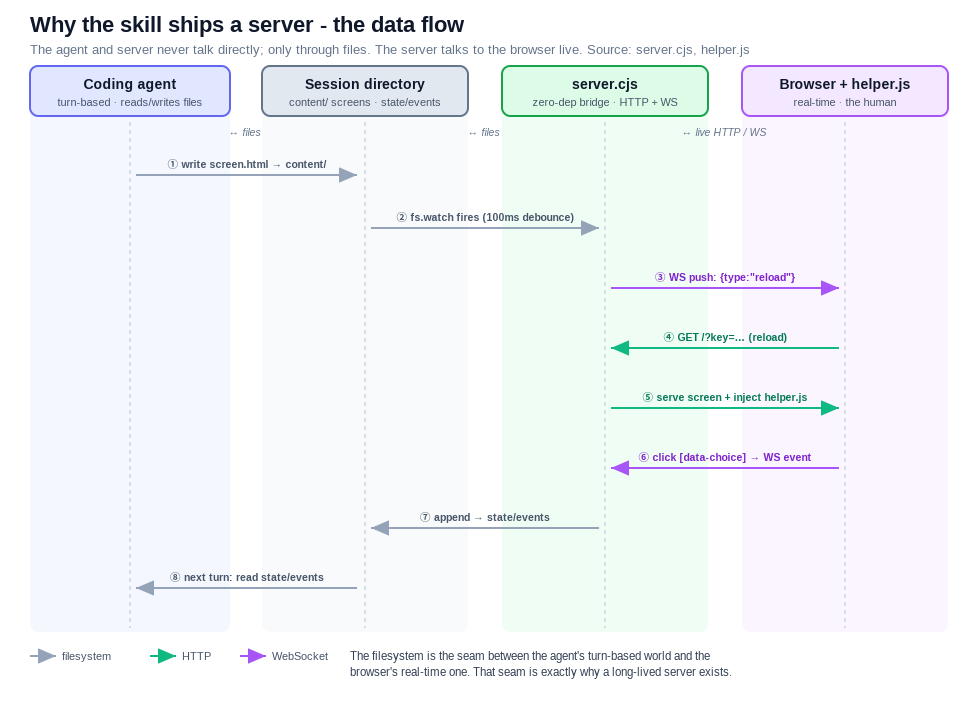
Trace the eight steps in the diagram:
- The agent writes a semantic HTML file into the session’s
content/directory (server.cjsreads this dir; the agent’s only job is to drop a file there). - The server’s
fs.watchon that directory fires, debounced ~100ms (server.cjs:590–613). - The server pushes
{type:"reload"}to every connected browser over the WebSocket (server.cjs:519–524, 611). - The browser re-requests
GET /?key=…(helper.js:100reloads on that message). - The server serves the newest screen by mtime, wraps a fragment in the frame template,
and injects
helper.js(server.cjs:406–419, 267–278). - The human clicks an option;
helper.jsships a WebSocket event back (helper.js:130–141). - The server appends that click to
state/events, one JSON object per line (server.cjs:513–516). - On its next turn, the agent reads
state/eventsand merges it with the terminal reply (this is the loop from Part 5).
The whole architecture falls out of one sentence: the filesystem is the seam between the agent’s turn-based world and the browser’s real-time world. The agent and the server never hold a connection to each other - the agent writes files and reads files; the server watches files and serves a browser. That decoupling is why a turn-based agent can drive a live UI at all.
Why zero dependencies - and a WebSocket written by hand
Open server.cjs and the first four lines are the whole dependency list
(server.cjs:1–4):
const crypto = require("crypto");
const http = require("http");
const fs = require("fs");
const path = require("path");
All four are Node built-ins. There is no express, no ws, no chokidar. That is deliberate,
and the design spec spells out why (2026-03-11-zero-dep-brainstorm-server-design.md:3,7):
“Replace the brainstorm companion server’s vendored node_modules (express, ws, chokidar - 714 tracked files) with a single zero-dependency
server.js… Vendoring node_modules into the git repo creates a supply chain risk: frozen dependencies don’t get security patches, 714 files of third-party code are committed without audit.”
So the server was rewritten to depend on nothing - which meant implementing the WebSocket
protocol by hand. server.cjs:6–81 is a compact RFC 6455 implementation: the SHA-1 +
magic-GUID handshake (computeAcceptKey, server.cjs:12–14), frame encode/decode across the
three length encodings, XOR-unmasking of client frames, and exactly four opcodes - TEXT, CLOSE,
PING, PONG (server.cjs:8). Binary frames, fragmentation, and extensions are deliberately
skipped because the only payloads are small JSON click events between localhost peers
(design spec:33). A 10 MB frame cap (server.cjs:10) guards against a hostile client.
This is what lets Superpowers’ own CLAUDE.md claim the project is “a zero-dependency plugin by
design.” The companion server isn’t an exception to that rule; it was rebuilt to honor it.
One honest caveat. Zero npm dependencies does not mean zero network calls. The companion’s frame optionally loads a Prime Radiant branding logo from a remote URL for rough usage telemetry (
server.cjs:106, 242–252). It’s opt-out - setSUPERPOWERS_DISABLE_TELEMETRY(orDISABLE_TELEMETRY) and the logo, and its request, are dropped (server.cjs:107–112, 244–249). The server code itself pulls in no third-party packages.
Why the extension is .cjs
A small detail with a real reason. The file does double duty (server.cjs:712–723):
if (require.main === module) {
  startServer();          // run directly: `node server.cjs` starts the server
}
module.exports = {        // required from a test: export the protocol functions
  computeAcceptKey, encodeFrame, decodeFrame, browserLauncherForPlatform, OPCODES, …
};
The .cjs extension pins the file to CommonJS regardless of any surrounding ESM package config,
so require() always works. That is what lets tests/brainstorm-server/ws-protocol.test.js
import encodeFrame/decodeFrame and unit-test the hand-rolled protocol in isolation - while
the same file, run directly, is the server. One file, two roles, exactly as the design spec
intended (design spec:11–14).
The security model: a localhost server that might not stay on localhost
This is the most interesting code in the folder, because the companion can be told to bind a
non-loopback host for remote/containerized setups (start-server.sh:11–12). The moment it does,
“it’s just localhost” stops being a defense. The server’s answer is a per-session key.
- On startup it mints a 32-byte hex token (
server.cjs:124–126) and bakes it into the served URL as?key=…(server.cjs:286–288). - Every request must carry that key - as the query param or as a cookie - and the comparison is
constant-time to avoid timing leaks (
isAuthorized,server.cjs:341–353;timingSafeEqualStr,server.cjs:321–326). No key →403(server.cjs:388–392). - On first load a tiny bootstrap page stashes the key in
sessionStorageand mirrors it into anHttpOnly; SameSite=Strictcookie (server.cjs:188–200, 398–399), so subsequent subresources and the WebSocket carry it automatically. - The WebSocket upgrade is gated by the same key plus an Origin check
(
server.cjs:445,isAllowedWebSocketOrigin,server.cjs:377–383), and responses carryX-Frame-Options: DENYandContent-Security-Policy: frame-ancestors 'none'(server.cjs:366–375). The comment is explicit that this combination is what defeats DNS rebinding, which a Host/Origin allowlist alone cannot (server.cjs:115–120). - Static file serving is hardened against path traversal:
isRegularFileInsideContentDir(server.cjs:304–317) rejects symlinks, hardlinks, and anything whose real path escapes the content directory.
For a feature whose pitch is “I’ll pop open a browser tab,” there is a surprising amount of adversarial thinking here - precisely because a careless version would be a local-network information leak.
Lifecycle: starting, surviving, and dying cleanly
A server spawned by a turn-based agent has a basic problem: who turns it off? The skill solves this with two independent shutdown triggers and a careful launch.
Starting (start-server.sh): it generates a unique session id ($$-timestamp,
start-server.sh:114), resolves the harness PID as the server’s owner - the grandparent of the
script, since the immediate parent is an ephemeral shell that dies when the script exits
(start-server.sh:153–159) - and backgrounds the server with nohup … & disown
(start-server.sh:180–183) so it survives the turn. It then polls the log for server-started
and re-checks that the process is still alive a beat later, to catch environments that reap
detached processes (start-server.sh:185–205). On Codex and Windows/Git Bash, which reap
background processes, it auto-switches to foreground mode (start-server.sh:97–107).
Surviving / dying (server.cjs): a watchdog runs every 60 seconds (server.cjs:640–644)
and shuts the server down if either the owner harness has exited
(ownerAlive via process.kill(pid, 0), server.cjs:634–637) or it has been idle past the
timeout (default 4 hours, server.cjs:552–557). If the preferred port is taken it falls back to
a random one exactly once (server.cjs:691–708). And when it gets its preferred port it persists
the port and token to .last-port/.last-token (server.cjs:663–680), so a restart with the
same --project-dir reuses them - which is why an already-open browser tab silently reconnects
instead of 403-ing (the tab’s cookie still validates).
Stopping (stop-server.sh): it refuses to kill a PID it can’t prove is this server,
matching a per-start instance id baked into the process’s command line
(stop-server.sh:43–71) - a stale PID file after a reboot fails closed as stale_pid rather
than risking signalling an unrelated process (stop-server.sh:78–83). It tries SIGTERM, waits
~2s, then escalates to SIGKILL (stop-server.sh:85–102). Ephemeral /tmp sessions are deleted;
persistent .superpowers/ sessions are kept so the mockups survive for later review
(stop-server.sh:112–115).
The client half: helper.js
The browser side is small but does the unglamorous work that makes the loop feel solid
(helper.js):
- Opens the WebSocket using the key from
sessionStorage(helper.js:25–35, 77–95). - Captures clicks on any
[data-choice]element and sends{type, text, choice, id}(helper.js:130–141); queues events while disconnected and flushes on reconnect (helper.js:120–127, 89–90). - Reconnects with exponential backoff from 500 ms to 30 s (
helper.js:1–8, 112–113). - After 15 s disconnected, paints a full-screen “Companion paused” overlay so the human
isn’t staring at a dead page (
helper.js:62–75, 103–111) - and tears it down and reloads through the keyed bootstrap when the server comes back (helper.js:82–95, 37–44). This is the same-port restart, seen from the browser’s side.
What the machinery teaches about the skill
Step back and the scripts are a small case study in the same values the prose half of the skill preaches:
- YAGNI, applied to dependencies. Three npm packages became zero by implementing only the 4 opcodes and 3 routes actually needed. The companion does the minimum a browser dialogue requires and not one feature more.
- Decoupling through a clean seam. The agent and server share files, not a connection - the
same “well-bounded units with a clear interface” idea the design section of
SKILL.mdespouses, expressed in process architecture. - Adversarial care. Constant-time keys, DNS-rebinding defense, path-traversal guards, and a kill-only-what-you-can-prove teardown - for a localhost convenience feature. It is the spec-self-review instinct (Part 4) turned on the runtime itself.
So: the scripts are there because one feature - and only one - needs to render in a browser and hear clicks back. Everything about how they’re built (zero-dependency, hand-rolled WebSocket, keyed auth, a filesystem seam, a self-terminating watchdog) follows from a single constraint: ship a live localhost server inside a zero-dependency plugin without letting it become a liability. That constraint, met carefully, is the whole story under the hood.
Sources
skills/brainstorming/scripts/server.cjs- lines 1–4 (built-ins only), 6–81 (RFC 6455 WebSocket), 115–150 & 321–353 & 366–399 (key auth, cookie, security headers), 304–317 (path-traversal guard), 387–438 (HTTP routes), 503–524 (WS messages & broadcast), 552–644 (idle timeout & owner-PID watchdog), 663–710 (port/token persistence, EADDRINUSE fallback, startup JSON), 712–723 (dual role /module.exports)skills/brainstorming/scripts/helper.js- lines 1–8 & 112–113 (backoff), 62–75 & 103–111 (paused overlay), 120–141 (click capture & queueing)skills/brainstorming/scripts/start-server.sh- lines 97–107 (auto-foreground), 113–124 (session dir), 153–159 (owner PID), 180–205 (background launch & alive check)skills/brainstorming/scripts/stop-server.sh- lines 43–83 (identity proof / fail closed), 85–115 (SIGTERM→SIGKILL, keep persistent dirs)docs/superpowers/specs/2026-03-11-zero-dep-brainstorm-server-design.md- lines 3,7 (motivation: 714 vendored files), 11–35 (single-file dual role; WebSocket protocol scope)CLAUDE.md- “Superpowers is a zero-dependency plugin by design”
← Previous: Part 5 - The Visual Companion · This appendix closes the series.
The series - Inside the Brainstorming Skill: 0 · The Map · 1 · Dialogue, Not Interrogation · 2 · The Interview Engine · 3 · From Answers to Design · 4 · The Spec Pipeline · 5 · The Visual Companion · 6 · Under the Hood (you are here)