“Inside the Brainstorming Skill” - Part 3 of 7. Once the interview converges, the skill stops asking and starts proposing - but never all at once: 2–3 approaches recommendation-first, then a design ratified one section at a time. Source-grounded in the Superpowers
brainstormingskill’s own files; every claim is citedfile:line.
The interview engine from Part 2 exits with three full buckets - purpose, constraints, success criteria. Now the skill changes mode. It stops drawing things out of you and starts putting a concrete design in front of you. But the Socratic discipline doesn’t switch off; it just changes shape. The design is still validated incrementally, still one piece at a time.
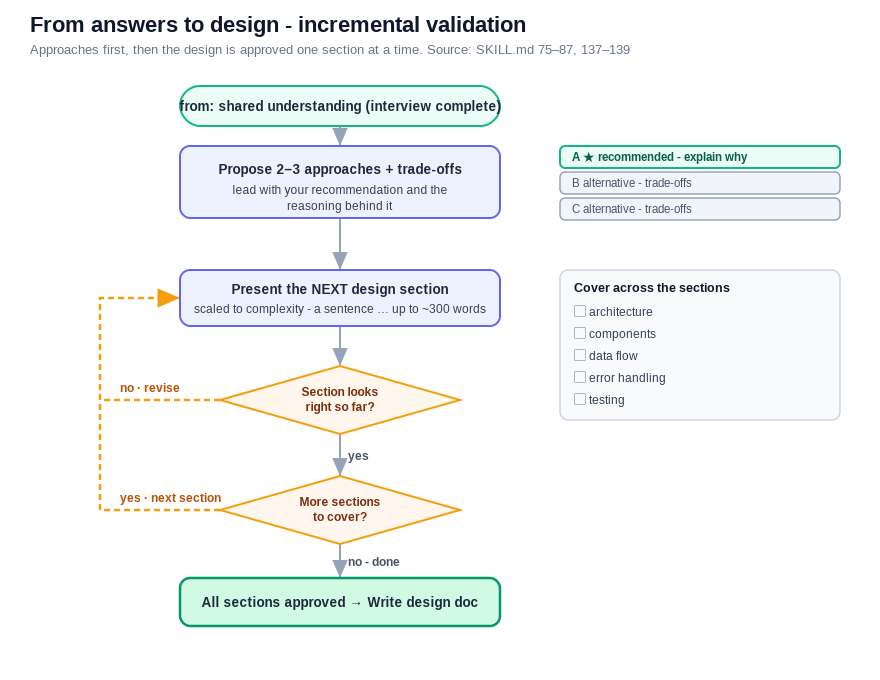
First: never let the first idea win by default
Before presenting a design, the skill forces a fork in the road:
“Propose 2–3 different approaches with trade-offs. Present options conversationally with your recommendation and reasoning. Lead with your recommended option and explain why.”
SKILL.md:77–79
Three things are happening in that instruction:
- Plurality is mandatory. Even when the agent is confident, it must surface 2–3 real
approaches. This is principle four from Part 1 - explore alternatives (
SKILL.md:138) - in practice. It prevents the very common failure where the first idea the agent thinks of silently becomes the only idea considered. - The recommendation leads. The agent does not present a neutral menu and shrug. It leads with its pick and the reasoning, so the human is reacting to a considered position, not doing the agent’s deciding for it.
- It stays conversational. This is a discussion, not a spec dump. The human can push back on the recommendation, and often that pushback is itself a requirement surfacing late.
In the diagram, this is the “A ★ recommended / B / C” cluster. The recommendation is highlighted because that is how the skill presents it - opinion first, alternatives in support.
Then: present the design in sections, scaled to complexity
With an approach chosen, the agent presents the actual design. The rule that governs how is about proportion:
“Once you believe you understand what you’re building, present the design. Scale each section to its complexity: a few sentences if straightforward, up to 200–300 words if nuanced. Ask after each section whether it looks right so far.”
SKILL.md:83–85
Two ideas worth separating:
Sections scaled to complexity. A trivial part of the design gets a sentence. A subtle part gets up to a few hundred words. The agent is not padding every section to the same length; it spends words where the risk is. This is the same instinct as YAGNI, applied to explanation rather than features - don’t over-produce where it isn’t earned.
Approval after each section. This is principle five - incremental validation
(SKILL.md:139) - and it is the Socratic method surviving into the design phase. The agent
does not present a finished 2,000-word design and ask “good?” at the end. It presents a piece,
asks “does this look right so far?”, and only then builds the next piece on top. The diagram
shows this as the “Section looks right?” loop: a no sends the agent back to revise and
re-present that same section; a yes advances to the next one.
What the sections must cover
The skill names the surface area a design is expected to span:
“Cover: architecture, components, data flow, error handling, testing.” -
SKILL.md:86
That checklist appears in the diagram as the coverage panel. It is not a rigid template - a simple project may touch some of these in a sentence each - but it is the agent’s reminder that a design is not just “what it does.” It is also how it’s structured, how data moves through it, how it fails, and how it’s proven. The inclusion of testing as a first-class design concern is notable: the skill treats “how will we know this works?” as part of the design, not an afterthought.
Designing for isolation
One more instruction shapes what kind of design the skill steers toward. It asks the agent to decompose the system into well-bounded units:
“Break the system into smaller units that each have one clear purpose, communicate through well-defined interfaces, and can be understood and tested independently. For each unit, you should be able to answer: what does it do, how do you use it, and what does it depend on?”
SKILL.md:91–92
And it gives a crisp test for whether the boundaries are good:
“Can someone understand what a unit does without reading its internals? Can you change the internals without breaking consumers? If not, the boundaries need work.”
SKILL.md:93
This is the skill encoding a design value, not just a process. A “good” brainstorming output
isn’t merely approved - it is modular, testable, and comprehensible in pieces. The same
section even notes the pragmatic reason: smaller, well-bounded units are easier for the agent
itself to reason about and edit reliably (SKILL.md:94).
Working inside an existing codebase
When there is already code, the skill adds a constraint and a permission:
- Constraint: “Explore the current structure before proposing changes. Follow existing
patterns.” (
SKILL.md:98) - Permission: where existing code has problems that affect the work, “include targeted
improvements as part of the design - the way a good developer improves code they’re working
in.” (
SKILL.md:99) - Limit: “Don’t propose unrelated refactoring. Stay focused on what serves the current
goal.” (
SKILL.md:100)
So the design phase is context-aware: it fits the new work into the grain of what exists, improves what it must touch, and resists the temptation to refactor the world.
The exit
When every section has been presented and approved, the design conversation is over. The output is a validated design - agreed section by section, scaled to complexity, modular by construction. The next step is to make it durable: write it down, review it, and get a final human sign-off before any planning begins. That is the spec pipeline, and it is Part 4.
Sources
skills/brainstorming/SKILL.md- lines 75–79 (approaches, recommendation-first), 82–87 (sections scaled to complexity, approval after each, coverage list), 89–94 (design for isolation), 96–100 (existing codebases), 137–139 (Key Principles: YAGNI, alternatives, incremental validation)
← Previous: Part 2 - The Interview Engine · Next: Part 4 - The Spec Pipeline →
The series - Inside the Brainstorming Skill: 0 · The Map · 1 · Dialogue, Not Interrogation · 2 · The Interview Engine · 3 · From Answers to Design (you are here) · 4 · The Spec Pipeline · 5 · The Visual Companion · 6 · Under the Hood