“Inside the Brainstorming Skill” - Part 2 of 7. The post the series exists for: how the skill converts a vague idea into a buildable design through a single tight loop - scope triage, pick the next unknown, ask exactly one question, end the turn, integrate, test for convergence. Source-grounded in the Superpowers
brainstormingskill’s own files; every claim is citedfile:line.
This is the post the series exists for. Parts 0 and 1 set up the machine and its principles; here we watch the Socratic method actually run. The “interview engine” is not a component you will find named in the source - it is the loop that emerges when the principles from Part 1 are applied turn after turn. This post reconstructs that loop from the skill’s own instructions and traces it gear by gear.
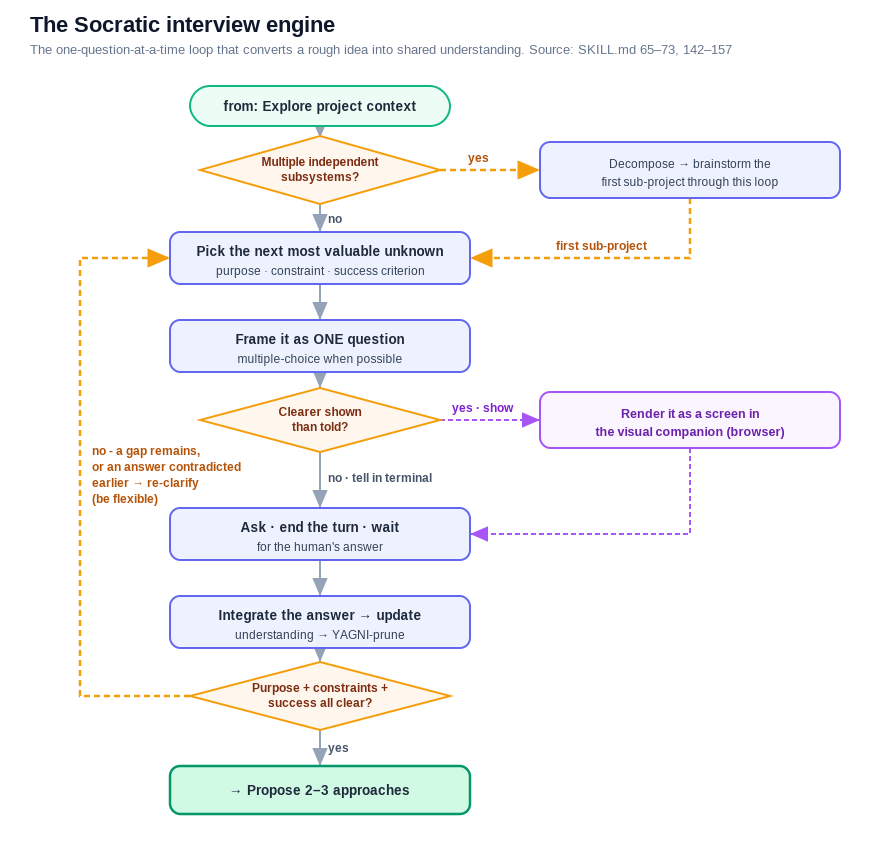
Follow the diagram alongside the walkthrough. The amber dashed line is the loop - and the loop is the whole story.
Before the first question: scope triage
The interview does not begin by asking about details. It begins by checking whether details are even the right thing to ask about yet. The skill calls this out explicitly:
“Before asking detailed questions, assess scope: if the request describes multiple independent subsystems (e.g., ‘build a platform with chat, file storage, billing, and analytics’), flag this immediately. Don’t spend questions refining details of a project that needs to be decomposed first.”
SKILL.md:68
If the request is too big for one design, the skill’s job changes from interview to decompose:
“If the project is too large for a single spec, help the user decompose into sub-projects: what are the independent pieces, how do they relate, what order should they be built? Then brainstorm the first sub-project through the normal design flow. Each sub-project gets its own spec → plan → implementation cycle.”
SKILL.md:69
This is the top diamond in the diagram. A “yes” routes out to decomposition and then re-enters the same loop for the first sub-project. A “no” drops straight into questioning. It is a guard clause: don’t run the interview on a question that is secretly four questions.
The loop, one turn at a time
Once scope is settled, the engine runs. Each pass through it is one conversational turn - and that constraint is what makes it Socratic rather than a questionnaire.
Step 1 - Pick the next most valuable unknown
The agent looks at what it still doesn’t know and selects the single most useful gap to close. The selection isn’t arbitrary; from Part 1 we know the target space is fixed:
“Focus on understanding: purpose, constraints, success criteria.” -
SKILL.md:73
So “the next unknown” is always a hole in one of those three buckets - why, what limits it, or what done looks like. The agent is, in effect, doing triage on its own ignorance.
Step 2 - Frame it as exactly one question
This is the hard constraint, stated twice in the source for emphasis:
“Only one question per message - if a topic needs more exploration, break it into multiple questions.” -
SKILL.md:72“One question at a time - Don’t overwhelm with multiple questions.” -
SKILL.md:135
And the framing bias:
“Prefer multiple choice questions when possible, but open-ended is fine too.” -
SKILL.md:71
A rich topic is not compressed into a dense multi-part question. It is split across multiple turns. This is the single rule that most distinguishes the skill’s behavior from an ordinary agent’s. An ordinary agent, asked to build something, fires a paragraph of questions to “be efficient.” This skill refuses - because a wall of questions forces the human to context-switch six times and answer shallowly. One question gets one considered answer.
Step 3 - Choose the channel (and maybe show instead of tell)
Before asking, the agent makes a per-question judgment: is this question clearer shown than told? Most questions are textual and stay in the terminal. But a question about layout, visual hierarchy, or a side-by-side comparison may be better as a rendered mockup in the visual companion (Part 5):
“Even after the user accepts, decide FOR EACH QUESTION whether to use the browser or the terminal. The test: would the user understand this better by seeing it than reading it?”
SKILL.md:151
In the diagram this is the second diamond. It does not change the loop’s logic - it only changes the medium of the question. The Socratic cadence is identical whether the question is a line of text or a clickable mockup.
Step 4 - Ask, then end the turn and wait
The agent asks its one question and stops. This is implicit but essential: a single question per message only means anything if the agent then yields the floor. The turn ends; the human answers. There is no batching, no “and while you’re at it.” The discipline of ending the turn is what makes the dialogue a dialogue.
Step 5 - Integrate the answer (and prune)
When the human replies, the agent folds the answer into its growing understanding - and, critically, prunes:
“YAGNI ruthlessly - Remove unnecessary features from all designs.” -
SKILL.md:137
Each answer can add scope, but it can also reveal scope that should be cut. Integration is not just accumulation; it is editing. The mental model of the design after turn N is sharper - sometimes smaller - than after turn N−1.
Step 6 - Test for convergence
Now the decisive question, which the agent asks itself, not the human: do I understand
purpose, constraints, and success criteria well enough to design? This is the convergence
test (SKILL.md:73 defines the three buckets; the surrounding flow defines the exit). Two
outcomes:
- Not yet - a bucket still has a gap → loop back to Step 1 and pick the next unknown.
- Yes - all three buckets are full enough → exit the interview and move to proposing approaches (Part 3).
The two reasons the loop runs again
The back-edge in the diagram carries two distinct meanings, and both come straight from the principles:
-
A gap remains. The ordinary case - the agent simply doesn’t know enough yet, so it asks the next question.
-
An answer contradicted an earlier assumption. Here the loop is corrective, not just additive. Principle six demands it:
“Be flexible - Go back and clarify when something doesn’t make sense.” -
SKILL.md:140This is what keeps the interview honest. When turn 5’s answer breaks an assumption made on turn 2, the agent does not paper over it - it loops back and re-clarifies. The flow bends.
Why “one question at a time” is the linchpin
It is tempting to read “one question per message” as a stylistic nicety. It is not. It is the mechanism that makes every other principle possible:
- It enables integration. You can only let answer N shape question N+1 if you ask them one at a time. Batched questions are frozen the moment they’re sent.
- It enables flexibility. Going back to re-clarify only makes sense in a turn-by-turn dialogue; you can’t “go back” inside a single mega-question.
- It enables convergence. The loop has a natural stopping point - all three buckets full - only because each turn closes one gap. A questionnaire has no convergence test; it just ends when the form runs out.
Take away one-at-a-time and the Socratic method collapses into a form. Keep it, and a vague sentence like “let’s make a react todo list” becomes, over a handful of patient turns, a design precise enough to build. That is the engine.
The output of the engine
When the loop exits, the agent is holding three full buckets - a clear sense of purpose, constraints, and success criteria. That shared understanding is the raw material for the next phase: turning it into a concrete design through approaches and incremental validation. That is Part 3.
Sources
skills/brainstorming/SKILL.md- lines 65–73 (understanding the idea; scope triage; one-at-a-time; MCQ; purpose/constraints/success), 68–69 (decomposition), 135–140 (Key Principles), 151 (per-question channel choice)
← Previous: Part 1 - Dialogue, Not Interrogation · Next: Part 3 - From Answers to Design →
The series - Inside the Brainstorming Skill: 0 · The Map · 1 · Dialogue, Not Interrogation · 2 · The Interview Engine (you are here) · 3 · From Answers to Design · 4 · The Spec Pipeline · 5 · The Visual Companion · 6 · Under the Hood