“Inside the Brainstorming Skill” - Part 1 of 7. The six principles behind every question the skill asks - one at a time, multiple-choice preferred, YAGNI-ruthless - and the three targets each question secretly aims at: purpose, constraints, success criteria. Source-grounded in the Superpowers
brainstormingskill’s own files; every claim is citedfile:line.
The previous post mapped the whole skill from above. Now we descend into the part that makes it Socratic: the rules that govern how it asks. Before we trace the question loop itself (that is Part 2), we need to understand the philosophy underneath it - because the loop is just these principles in motion.
”Natural collaborative dialogue”
The skill frames its method in its second sentence:
“Help turn ideas into fully formed designs and specs through natural collaborative dialogue. Start by understanding the current project context, then ask questions one at a time to refine the idea.”
SKILL.md:8,10
That word “dialogue” is doing real work. A non-Socratic agent treats requirements as a
form to be filled: it dumps ten questions, collects ten answers, and proceeds. The
brainstorming skill refuses that. It insists on a back-and-forth where each answer informs the
next question. The repo summarizes this posture as “Socratic design refinement”
(README.md:232) - drawing the design out of the human, one exchange at a time.
The six principles
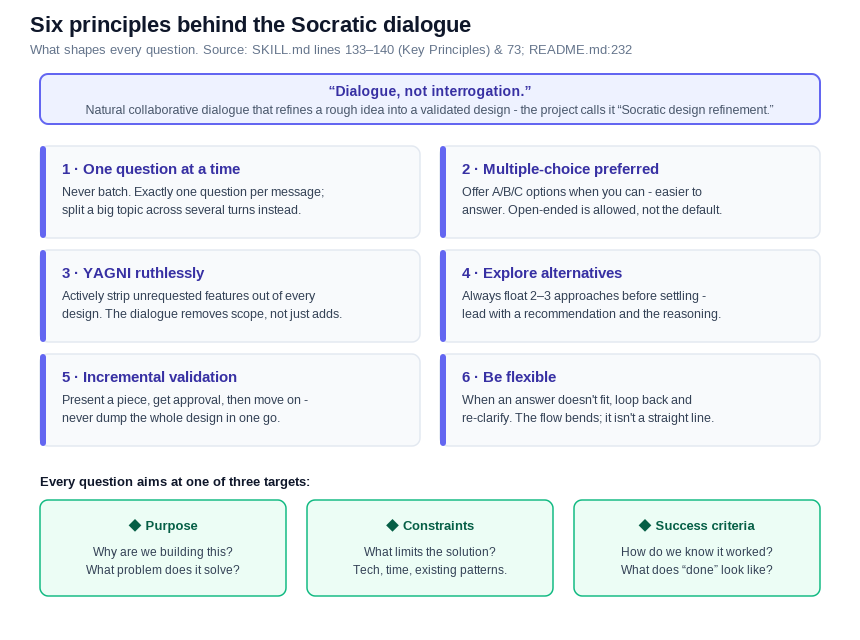
At the bottom of the skill is a section called Key Principles (SKILL.md:133–140). These
six rules are the constitution of the dialogue.
1. One question at a time
“Don’t overwhelm with multiple questions.” -
SKILL.md:135
Reinforced in the process notes:
“Only one question per message - if a topic needs more exploration, break it into multiple questions.” -
SKILL.md:72
This is the single most characteristic behavior of the skill, and Part 2 is devoted to it. The constraint is absolute: exactly one question per message. If a topic is rich, it becomes several turns, not one crowded turn.
2. Multiple-choice preferred
“Easier to answer than open-ended when possible.” -
SKILL.md:136“Prefer multiple choice questions when possible, but open-ended is fine too.” -
SKILL.md:71
A subtle but important bias. Open-ended questions (“What do you want?”) put the cognitive load on the human. Multiple-choice questions (“A, B, or C?”) put it on the agent, which has to do the work of enumerating real options first. The skill prefers the latter - it is a more considerate, and more decisive, way to interview.
3. YAGNI ruthlessly
“Remove unnecessary features from all designs.” -
SKILL.md:137
“YAGNI” - You Aren’t Gonna Need It. This is the only principle that removes rather than gathers. The dialogue is not just additive; part of its job is to talk scope down, not just up. A good brainstorming session ends with a smaller, sharper idea than it started with.
4. Explore alternatives
“Always propose 2–3 approaches before settling.” -
SKILL.md:138
The skill never lets the first idea win by default. Even when the agent has a clear preference, it must surface alternatives so the choice is made consciously. (Part 3 covers how these approaches are presented - recommendation first.)
5. Incremental validation
“Present design, get approval before moving on.” -
SKILL.md:139
Approval is not a single event at the end. It is granted piece by piece. This is what keeps a long design conversation from collapsing at the finish line - each section is ratified before the next is built on top of it.
6. Be flexible
“Go back and clarify when something doesn’t make sense.” -
SKILL.md:140
The flow is a loop, not a line. If an answer contradicts an earlier assumption, the agent is expected to circle back and re-clarify rather than barrel forward. The diagrams in this series show that as dashed back-edges, and they are not decoration - they are the mechanism.
What every question is secretly aiming at
The principles tell the agent how to ask. One more line tells it what to ask about:
“Focus on understanding: purpose, constraints, success criteria.” -
SKILL.md:73
Every well-formed brainstorming question is a probe toward one of three targets:
- Purpose - why are we building this? What problem does it solve?
- Constraints - what limits the solution? Existing patterns, tech, time.
- Success criteria - how will we know it worked? What does “done” look like?
This is the quiet engine of the Socratic method here. The agent is not collecting trivia; it is filling in three specific buckets. When all three are full enough to design against, the interview is over - which is exactly the convergence test we will see in Part 2.
Why this is “Socratic” and not just “asking questions”
Socratic questioning, classically, is the practice of drawing knowledge and clarity out of someone through structured questions rather than lecturing them. Map that onto these six principles and the fit is exact:
- one question at a time → the patient, turn-by-turn cadence of a dialogue;
- multiple-choice and “purpose/constraints/success” → questions aimed at eliciting the human’s own latent requirements;
- be flexible / go back → following the answer where it leads, not a fixed script;
- YAGNI → using questions to strip away the unexamined, not just accumulate.
The skill never claims the Socratic mantle in its body. It simply behaves that way, by rule. In the next post we watch those rules run as a single tight loop.
Sources
skills/brainstorming/SKILL.md- lines 8–10 (dialogue), 70–73 (one-at-a-time, MCQ, purpose/constraints/success), 133–140 (the six Key Principles)README.md:232- “Socratic design refinement”
← Previous: Part 0 - The Map · Next: Part 2 - The Interview Engine →
The series - Inside the Brainstorming Skill: 0 · The Map · 1 · Dialogue, Not Interrogation (you are here) · 2 · The Interview Engine · 3 · From Answers to Design · 4 · The Spec Pipeline · 5 · The Visual Companion · 6 · Under the Hood