“Beyond Coverage: Test Quality for the Agentic Loop” - Part 6 of 7 (closing part). Six parts of metrics, evidence, tooling, and AI-test grading converge here into one scorecard and a rollout plan - scored on the diff, module by module, never on the repo as a whole.
Score the diff, not the repo. A change is safe to merge without manual testing when, on the lines it touches: mutation score ≥ 80%, diff coverage ≥ 90%, zero test smells, ~0% flakiness, and critical paths carry strong (mutation + property) oracles. You reach the loop module-by-module, hardening the crown jewels first - never by chasing one repo-wide number.
The scorecard (apply per PR, to changed code)
| Dimension | Metric | 🔴 Not ready | 🟡 Workable | 🟢 Loop-ready |
|---|---|---|---|---|
| Oracle strength ★ | Mutation score on the diff | < 50% | 60–75% | ≥ 80% |
| Change exercised | Diff / changed-line coverage | < 60% | 70–80% | ≥ 90% |
| Assertions exist | Assertion density + smell scan | smells present | ≥1 assert/test | 0 smells, behavioural |
| Reliability | Flakiness (5× rerun) | > 1% | ≤ 0.5% | ≈ 0%, flakes quarantined |
| Critical paths | Mutation + property tests on money/auth/data-loss | gaps | covered | ≥ 90% mutation + invariants |
| Speed | Suite + diff-mutation runtime | hours | ~10 min | diff-scoped, minutes |
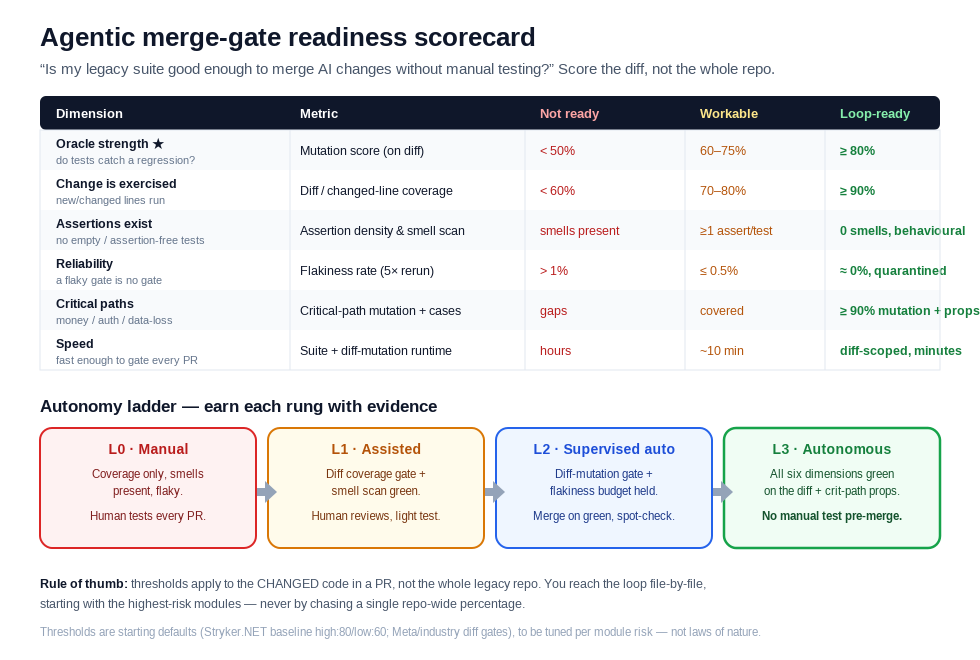 “Is my legacy suite good enough to merge AI changes without manual testing?” Score the diff, not the whole repo.
These are starting defaults (Stryker.NET’s high:80 / low:60 baseline; Meta/industry diff
gates), to be tuned per module risk - not laws of nature. The payment path should be
stricter; a logging helper can be looser.
The autonomy ladder - earn each rung with evidence
You don’t flip a switch to “autonomous.” You climb:
- L0 · Manual - coverage only, smells present, flaky. Human tests every PR. (Most legacy code starts here.)
- L1 · Assisted - diff-coverage gate + smell scan are green. Human still reviews and lightly tests.
- L2 · Supervised auto - diff-mutation gate green + flakiness budget held. Merge on green, human spot-checks.
- L3 · Autonomous - all six scorecard dimensions green on the diff, critical paths carry properties. No manual test before merge.
The jump that actually buys you the loop is L1 → L2: adding the mutation gate. Coverage gates (L1) stop obviously-untested merges; mutation gates (L2) stop vacuously-tested merges - including the AI’s vacuous tests (Part 5).
”Is my legacy suite good enough?” - the decision procedure
Run this, in order, scoped to the code a given change touches:
- Coverage zeros? Any changed/critical line at 0% → not ready. (Coverlet /
go test -cover.) Cheap, do it first. - Surviving mutants? Run diff-scoped mutation (
stryker --since/gremlins --diff). Read the survivors. Each is a missing assertion or case. Zero non-equivalent survivors on the diff = the strong signal you want. - Smell scan clean? No assertion-free, magic-number, conditional-logic, or act-assert-mismatch tests on the change.
- Critical path hardened? For money/auth/data-loss, is there a property/invariant test, not just examples?
- Flake-free & fast? 5× rerun stable; run completes in minutes.
If 1–5 pass on the diff, that change is loop-ready even if the rest of the legacy repo is a swamp. That’s the whole point: you don’t have to fix the legacy repo to start the loop - you have to fix the blast radius of each change.
Rollout strategy for a legacy codebase
- Pick the crown jewels. Identify the modules where a silent bug is catastrophic. For a
billing/payments system, for example: money calculation, the scheduled batch-run
orchestration, payment idempotency (a unique reference), due-date rules, money
rounding (
decimal(18,2)). - Baseline them. Run mutation once on those modules. The survivor list is your test-hardening backlog - prioritized by risk, handed to you (or the agent) for free.
- Turn on the diff gate (
--since/--diff) in CI for those modules at L2 thresholds. - Add properties to the math. Invariants over generated inputs (“paid ≤ owed”, “rounding conserves cents”, “due date always lands on the configured business day”) catch the classes of bug examples miss.
- Quarantine flakes ruthlessly. A flaky gate is no gate. Time-dependent logic
(
DateTime.Now, a scheduled-date calc) is the usual culprit - inject the clock so tests are deterministic. - Expand outward module by module. Track coverage of the diff and mutation score of the diff over time, not a repo-wide percentage.
- Wire in the AI gauntlet (Part 5): agent-generated tests must kill a new mutant to merge.
What “enough tests” finally means
Not a coverage number. Enough is when, for the code you’re changing:
there are no surviving non-equivalent mutants, the assertions are behavioural and smell-free, the critical invariants are properties, and the suite is fast and flake-free - so a passing build is genuine evidence the change is safe.
When that holds on a module, you can let the agent change that module and merge on green without manually testing - because the measurement, not the model’s confidence, is what’s vouching for the change. That is the full agentic loop, earned rather than assumed.
One-screen checklist (pin this)
PER-PR MERGE-GATE (scoped to the diff)
[ ] Diff coverage ≥ 90%            (Coverlet / go test -cover)
[ ] No coverage zeros on changed/critical lines
[ ] Diff mutation score ≥ 80%      (Stryker --since / gremlins --diff)
[ ] Zero surviving non-equivalent mutants on changed lines
[ ] Smell scan clean (no assertion-free / magic-number / cond-logic / act-assert mismatch)
[ ] Critical paths: property/invariant tests present (FsCheck/CsCheck · gopter/rapid)
[ ] Flakiness ≈ 0 (5× rerun stable); time/network injected, not ambient
[ ] Gate runs in minutes (diff-scoped, baseline/incremental)
[ ] AI-generated tests: each kills ≥1 new mutant; oracle traces to spec, not current code
The whole series in one line: coverage tells you what you’re blind to; mutation score tells you what your tests would actually catch; neither is a silver bullet alone - but scoped to the diff, combined, and used as a gate rather than a grade, they’re enough to let an agent merge on green.
Sources
- Stryker.NET thresholds/flags (defaults
high:80/low:60): https://stryker-mutator.io/docs/stryker-net/configuration/ (per docs; not independently re-verified this run). - Diff-based industrial mutation: State of Mutation Testing at Google, https://research.google/pubs/state-of-mutation-testing-at-google/ (confirmed 2-1).
- AI-test gating on mutants not coverage: Meta TestGen-LLM & follow-up, https://arxiv.org/abs/2402.09171 · https://arxiv.org/abs/2501.12862.
- Incremental gate starting points (achievable diff thresholds, raise over time): practitioner guidance, https://getautonoma.com/blog/quality-gate-vibe-coding.
← Previous: Part 5 - Grading AI-Generated Tests · This closes the series.
The series - Beyond Coverage: Test Quality for the Agentic Loop: 0 · Why Coverage Lies · 1 · The Metric Catalog · 2 · Mutation Testing, Properly Explained · 3 · What the Empirical Research Actually Says · 4 · Tooling for Go and .NET · 5 · Grading AI-Generated Tests · 6 · The Readiness Rubric (you are here)